
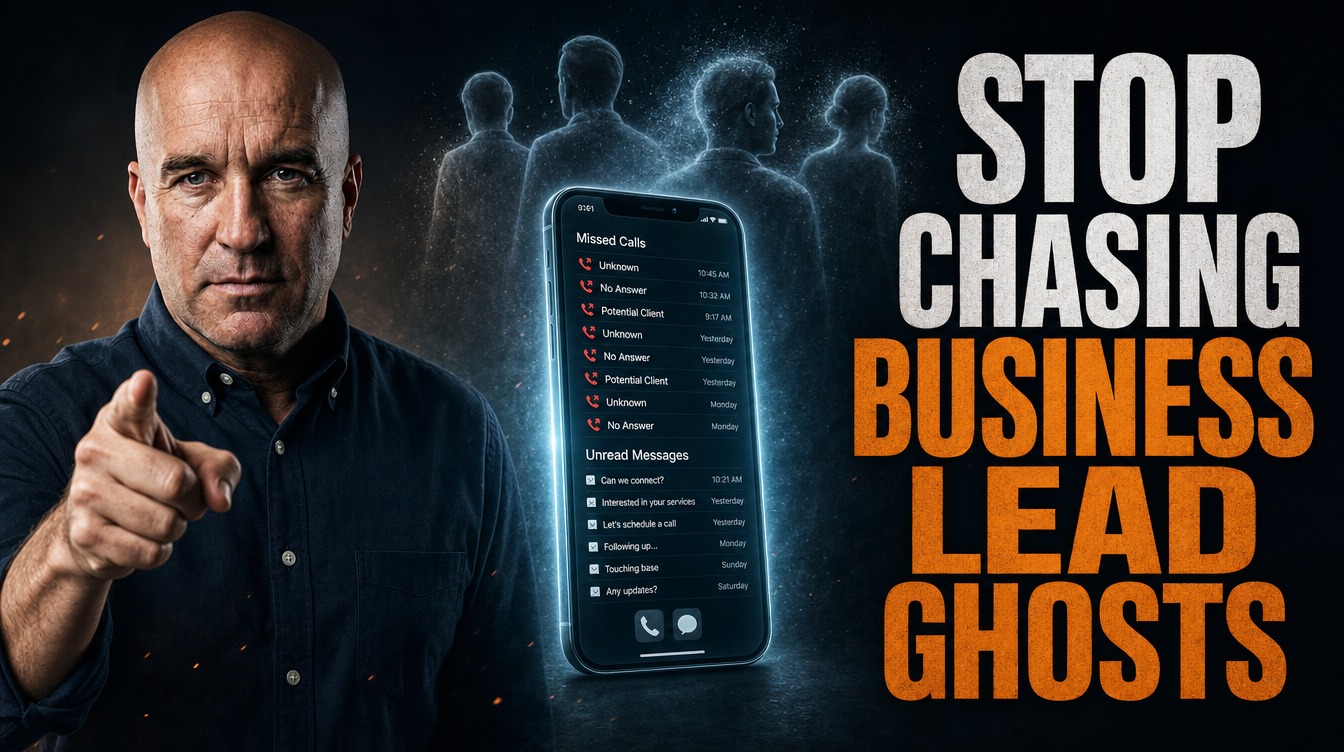
Pull up the last sixty people who contacted your business.
Now tell me what happened to number 31.
You cannot. Nobody can. She filled out a form in April, somebody meant to call her back, the week got loud, and she quietly hired the other guy. You paid to get her attention and then you let her walk out the side door.
That is the ghost. Not a stranger who never heard of you. A person who came to you, out of their own free will, and got silence.
You do not have a lead generation problem. You have sixty ghosts.
Nobody Is Cold. They Are Unassigned.
The whole industry taught you to sort people into cold, warm, and hot, like a lead is a temperature that happens to it on its own. That framing is the disease. It makes forgetting somebody feel like weather instead of a decision.
Leads do not go cold. They go unassigned.
Somebody raised a hand. Nobody owned the next move. Time passed, and now calling them feels awkward, so you tell yourself they were never serious anyway and you go buy new strangers to replace the ones you already had.
That is the most expensive habit in small business. You pay full retail for attention, use ten percent of it, and buy more.
Every play below is about the same thing: making sure a human being owns the next move, and that the move has a date on it.
Call the Ninety Day Ghosts First
Start where the money already is.
Pull everyone who contacted you in the last ninety days and never bought. Not the two year old list. Ninety days. These people still remember you and still have the problem that made them reach out.
Call them. Actual phone, actual voice. Not an email, because email is what they got the first time and it did not work.
The script is short and it is not a pitch.
"Hey, this is Chris at Kingdom Media. You reached out back in June about your website and I dropped the ball on getting back to you. That is on me. Are you still dealing with that, or did you get it handled?"
That is the whole thing. You name the gap, you take the blame, you ask one question. No enthusiasm, no offer, no pretending you were "just following up."
Half will say they went elsewhere. Fine. A meaningful slice will say they never got around to it, which means the job is still sitting there, unclaimed, waiting for whoever calls first.
Answer in Five Minutes or Do Not Bother Answering
Now stop creating new ghosts.
The single biggest predictor of whether an inbound lead converts is not your price, your reviews, or your portfolio. It is how fast a human responds. Response inside five minutes has beaten response inside an hour by a wide margin in every study of inbound leads for the last fifteen years, and the gap has only gotten worse as people got less patient.
Meanwhile most small businesses respond the next business day. Some take three.
Here is what actually happens in that gap. Your prospect did not contact only you. They filled out three forms in eleven minutes because that is how people shop now. Whoever calls first frames the entire decision. Everybody after is comparison shopping against a person who already has the relationship.
You do not need to be better than your competitors. You need to be first.
Set an automatic acknowledgment inside five minutes, any hour, that confirms you got it and names the exact time a person will call. Then have a person call inside the hour during business time.
Follow Up Six Times, Not Twice
Most businesses follow up once, maybe twice, then decide the person is not interested.
Two touches is not persistence. Two touches is a coin flip.
Run six over eighteen days, and vary the channel because people answer different things. Day one, call plus a text. Day three, a short email with one useful thing and no ask. Day seven, a call. Day twelve, a text with a specific question. Day eighteen, the close out.
That last one is the play nobody runs and it is the best of the six.
"Hey, I have reached out a few times and I do not want to be that guy. I am going to close your file. If the timing changes, call me direct."
It works because it is honest, it removes the pressure, and it triggers the very human urge to not lose an option. The number of deals that come back to life on the close out message is genuinely stupid.
Nobody is annoyed by six professional touches over eighteen days. You are worried about being annoying because you would be annoyed, and you are not the customer.
Put a Name and a Date on Every Single One
Everything above collapses without one rule.
Every lead has one human owner and one date. Not a team. Not the shared inbox. A person, by name, and a calendar date for the next move.
Shared responsibility is how ghosts get made. When "we" are following up, nobody is following up, and everybody assumes somebody else has it. Two weeks later you find her in the folder and it is too late to be anything but embarrassing.
If your setup cannot show you, in ten seconds, every lead with no owner or no date, that is the thing to fix before you spend another dollar on ads.
This is the same discipline that turns a dead database into a pipeline, and we broke down the full version in Your CRM Is a Dumpster Fire.
Send the Boring Email Every Month
The people who are not ready yet are not worthless. They are early.
Somewhere between a third and half of the people who contact you have a real need and bad timing. Budget is next quarter. The season is wrong. The spouse is not on board yet. If your only two settings are hard sell and total silence, every one of them is gone by the time they are ready.
So send one email a month. One. Plain text, from your actual name, and useful whether or not they ever hire you.
What you did for somebody. What it cost. What you learned. One specific thing they could do themselves this week.
It is boring and it is not clever and that is exactly why it works. Twelve months of quiet usefulness means that when the timing finally arrives, you are the only name in the running, and you never had to compete on price to get there.
Lake Ozark Lighting is the proof. Twenty four weeks, $44,000 in booked work, zero dollars in ads. Not because we found them new strangers. Because we stopped losing the ones they already had.
Text the Voicemail You Just Left
Small mechanical fix, outsized return.
Nobody listens to voicemail. You know this because you do not listen to yours. Yet operators keep leaving them, marking the lead as contacted, and wondering why the callback rate is near zero.
Leave the voicemail anyway, because it costs nine seconds and it proves you are real. Then immediately text the same person one line.
"Just left you a voicemail, it is Chris with Kingdom Media about your gutter job. Easier to text me back here if that works."
You just moved the conversation onto the channel people actually answer, and you did it without another call. Texts get read in minutes. Voicemails get deleted in bulk on Sunday night.
One caution. Text like a person, not a marketing department. No links in the first message, no offers, no "Hi FIRSTNAME." A single human sentence with your name and the specific job. Anything that smells like a blast gets you blocked, and a blocked number is a ghost you can never call back.
Kill Your Longest Form Today
Last one, and it takes four minutes.
Go look at your contact form. Count the fields. Every field past three is a person deciding not to bother.
Name, phone, and one open box. That is it. You do not need their budget range, their timeline, their address, their company size, or how they heard about you. You will get all of that in the first thirty seconds of an actual conversation, which is where it belongs.
The objection is always the same: a short form lets unqualified people through. Correct. It also lets qualified people through, and right now your seven field form is filtering out serious buyers who are standing in a parking lot on their phone with two bars.
You cannot ghost a lead you never received. But you also cannot close one.
Questions People Actually Ask
How long should I keep following up on a lead?
Six touches over roughly eighteen days for an active inquiry, then move them to a monthly email list rather than dropping them entirely. Most sales happen after the fourth contact, which is well past where the average small business gives up. The close out message on the final touch reopens a surprising number of deals.
Is it too late to call someone who inquired months ago?
No, and the older it is the more the honest opening matters. Name the gap, take responsibility for it, and ask whether the problem is still there. Ninety day old inquiries convert well. Even year old ones produce work, because most people never actually solved the thing.
How fast do I really need to respond to a new lead?
Five minutes to first contact, and it can be automated. Your prospect almost certainly contacted two or three businesses in the same sitting, and the first real response frames the whole decision. Next day responses are competing for scraps.
What should I say in a follow up so it does not sound desperate?
Ask a question instead of making an offer. "Are you still dealing with that?" outperforms "just checking in" because it is about their problem rather than your pipeline. Desperation comes from pitching, not from persistence.
Should I buy lead lists to fill my pipeline?
Fix your conversion before you add volume. If you are converting the leads you already paid for at a low rate, buying more just increases the cost of the same result. Purchased lists also start cold, which is the hardest and most expensive place to start.
That Is the Sticky Note
Sixty people raised their hand. Somebody has to call them.
It is you. It is today.
Back to work.
Stop losing the leads you already paid for.
Smart Website Core. $297/mo. Done for you. Live in 7 to 14 days.
Build Your Smart WebsiteJoin 2,500+ operators reading every week.