
You lost that job on Tuesday at 4:12 PM.
That is when the homeowner called three companies. Two of them answered. One of them gave a number on the phone. You said you would get something over to them, then you got on a roof, then you got stuck in traffic, then you sat down at 9:40 PM and stared at a blank estimate form.
Your quote went out Thursday. It was the better quote. It lost.
Then you told yourself the same thing everybody tells themselves. They went cheaper.
Maybe. Usually not.
This Is Not a Pricing Problem. It Is a Decision Problem.
People do not buy the lowest price. They buy the first offer that lets them stop thinking about it.
Every request for a quote is a person carrying a problem they are tired of carrying. A leaking roof. A website that embarrasses them. A wedding in eleven weeks. They want the problem gone. Your job is not to be cheap. Your job is to be the easiest yes on the list.
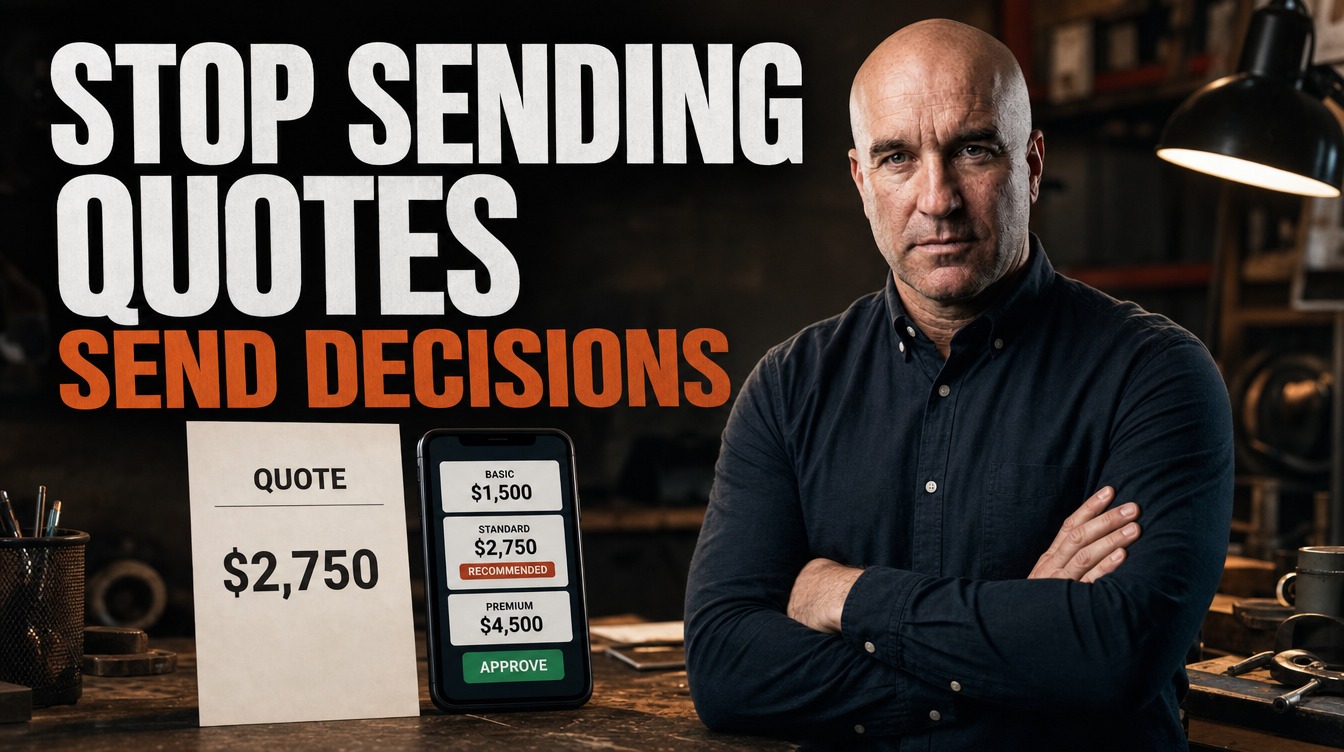
A quote is a price. A decision is a price plus clarity plus a way to say yes right now.
Most small businesses send prices. Then they wait, and they call it the market being slow.
Send a Number the Same Day, Even If It Is a Range
The first credible number sets the frame everybody else gets measured against. Being second means arguing with a number you did not choose.
You do not need the full estimate that day. You need a number.
Run it like this. When a request comes in, reply within a couple of hours with three things: the range this kind of job usually lands in, what makes it go to the top or bottom of that range, and the exact date the itemized number will arrive.
"Jobs like this usually run $4,800 to $7,200. The spread depends on deck condition and whether we are hauling the old material. I will have your itemized number Thursday by noon."
That message takes ninety seconds to write. It does three things a two-day silence cannot. It proves you know the work. It filters out the person whose budget was $900, before you spend an evening writing for free. And it plants your range as the reference point.
Build five of those ranges this week for your five most common jobs. Save them as text snippets on your phone. You are not committing to a price. You are refusing to go silent.
Put Three Prices on the Page, Not One
One price gets a yes or a no. Two prices get compared. Three prices get chosen.
Give every quote a Good, a Better, and a Best. Not three different jobs. The same job at three depths of care.
Good is the fix. Better is the fix plus the things that keep it from coming back, and this is the one you recommend in writing. Best is Better plus the pieces most people skip until year three.
Put a one-line reason under each. Not features. Reasons. "Better is what we install for our own families, because the flashing is where these fail." Mark the recommended tier. People want to be told what a professional would do.
Watch what happens to the conversation. It stops being "should I do this" and turns into "which one am I doing." Those are different questions with very different close rates.
One rule so this does not become a trap. Good has to be a real, honest option you would actually stand behind. Building a fake bottom tier to shove people up a level is a dark pattern, and it comes back on you in reviews.
Write the Exclusions Before the Customer Finds Them
Every unspoken assumption in your quote becomes an argument later, or a silence now.
Buyers who have been burned once read your quote hunting for what is missing. When they cannot tell, they stall. Stalling looks exactly like losing.
So say it out loud. A short block near the bottom, plain language.
What is included. What is not included. What could change the price and by roughly how much. Who pulls the permit. Who cleans up. What happens if you open the wall and find something ugly.
That last line is worth money. "If we open the wall and find rot, we stop, photograph it, text you the number, and nobody spends a dollar until you approve it." An owner reads that and relaxes, because the thing they are actually afraid of is not your price. It is the surprise invoice.
Ugly truths in writing close better than pretty vagueness.
Make the Yes One Click, Not One Meeting
Here is where most quotes die of natural causes.
The price is right, the customer is sold, and the next step is "let me know how you want to proceed." Now the yes requires them to write an email, remember a phone call, or wait for you to follow up. That is friction sitting directly on top of your revenue.
Delete it. Every quote goes out with one link that does the whole handoff: approve the tier, sign, pay the deposit, pick a start window.
If you use a CRM, Jobber, Housecall Pro, QuickBooks, or honestly any invoicing tool from the last decade, this already exists in the product. Turn it on. If you truly have nothing, a payment link and a text that says "reply YES to the tier you want and I will send the schedule" beats a PDF attachment with no next step.
Then get the timing right. Send the quote when they can act on it, not at 11:40 PM when it lands under nine other emails.
Publish Your Starting Prices Where Machines Can Read Them
Half your quote requests are not shopping. They are asking permission to find out if you are in their universe.
Put ranges on your site. A pricing page, or a price block on each service page. "Most kitchen refreshes run $12K to $30K." "Our monthly website plans start at $297."
Three things happen. Tire kickers screen themselves out. Serious buyers trust you faster, because hiding the number reads like a setup. And the answer engines finally have something to quote when somebody asks ChatGPT what a service like yours costs in your city.
That last part is the one nobody is doing yet. AI answers cite the pages that state facts plainly. Vague brochure copy gives them nothing to lift, which is the same reason most sites are invisible to AI search.
You are not publishing a final price. You are publishing a floor and a range, with a sentence on what moves it. A lighting installer we work with went from $0 to $44K in twenty four weeks with no paid ads, and a plain page that told people what things cost was part of the reason the phone calls that came in were already qualified.
Follow Up on Your Calendar, Not Their Conscience
Sent quotes do not die. They get forgotten by both parties at the same speed.
Three touches, scheduled the moment the quote goes out. Day two, a text with one useful sentence and no pressure. Day five, a call. Day twelve, the closer: "Are we a go, a not yet, or a no? Any of the three is fine, I just need to know whether to hold your spot."
That question is not aggressive. It is a relief. People answer it because you gave them permission to say no.
Everything else about resurrecting cold ones lives in the play on chasing lead ghosts. The point here is narrower. The follow-up gets scheduled when you hit send, not when you happen to remember on a slow Friday.
Grade Your Quotes Once a Month
You know your revenue. You probably do not know these four numbers, and they are the entire game.
How many quotes went out last month. How many closed. How long between the request and the number landing. What your average closed job was worth.
Ten minutes, first Monday of the month. Write the four numbers on the same sticky note every time so you can see the trend.
Once you can see it, you can move it. Cut your response time in half and your close rate moves before your ad spend does. Add a recommended tier and your average job size climbs without raising a single price. Marketing gets the blame for slow months, and quoting is usually where the money actually leaked out.
Frequently Asked Questions
How fast should I respond to a quote request?
Same business day, inside two hours if you can. You do not need the final estimate that fast, just a range and a promised delivery date. The first credible number usually sets the standard the rest get judged against.
Should I put pricing on my website?
Yes, as ranges with a note on what changes them. It screens out people who were never going to buy, it builds trust with people who were, and it gives AI answer engines a real number to cite when somebody asks what your service costs.
Why do customers ghost me after I send a quote?
Usually because the quote left them with unanswered questions and no easy way to say yes. Add exclusions in plain language, mark a recommended option, and include one link that approves, signs, and takes a deposit.
Is good, better, best just an upsell trick?
Only if the bottom tier is fake. Done honestly, every tier is a job you would proudly deliver, and the customer picks the depth of care they want instead of deciding whether to hire you at all.
How many times should I follow up on an unaccepted quote?
Three scheduled touches over about two weeks, then one clean question: go, not yet, or no. Then stop, tag them, and check back in ninety days.
That is the Sticky Note. Your quote is not a price sheet, it is the last thing standing between a person with a problem and the relief of handing it to somebody.
Send decisions. Back to work.
Send a decision, not a price sheet.
Smart Website Core. $297/mo. Done for you. Live in 7 to 14 days.
Build Your Smart WebsiteJoin 2,500+ operators reading every week.