
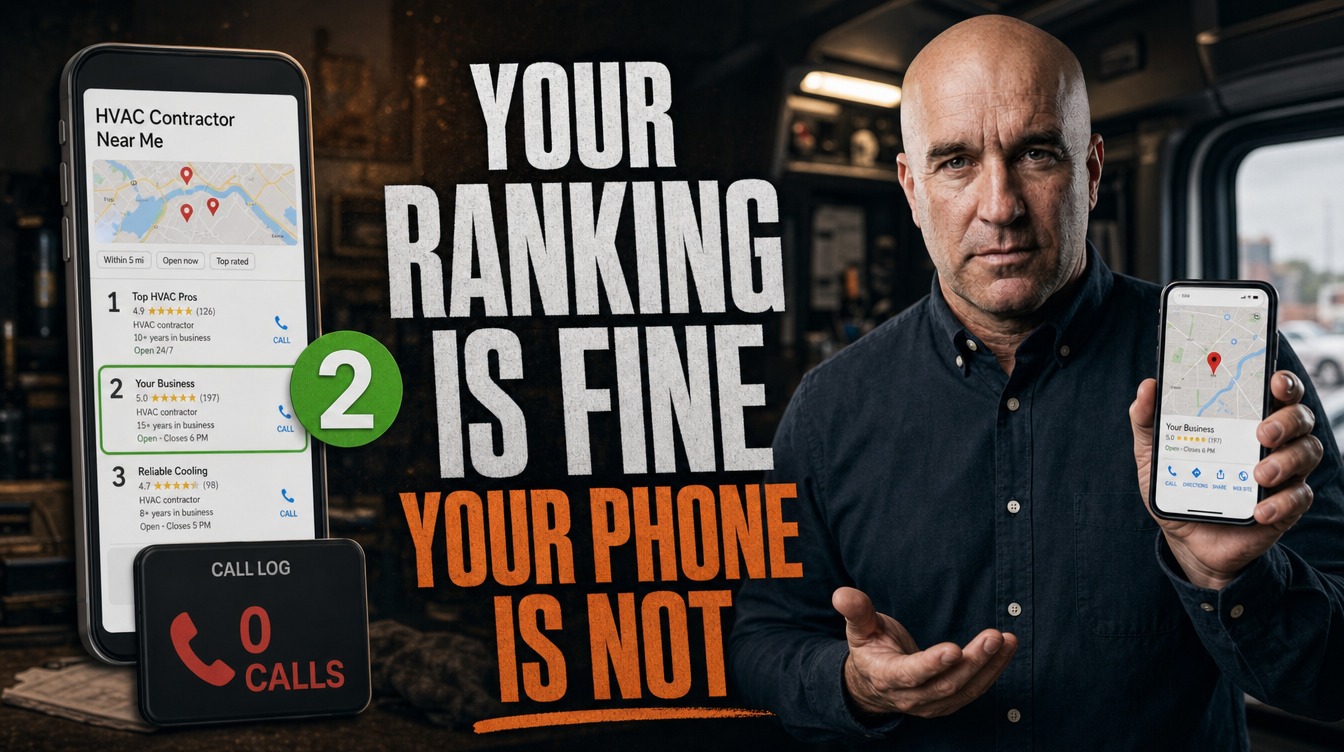
You pulled up the rank tracker Friday. Still number two in the map pack. Still page one for "AC repair near me." Green across the board.
Then you looked at the call log. Eleven calls last month. It was thirty-one in the spring, with the same rankings and the same ad spend.
Nothing broke. You did not get penalized. Your web guy is not stealing from you. The thing that changed is that fewer people have to click anything to get their answer, and the answer they get is being assembled from stuff you never bothered to fill out.
This Is Not a Ranking Problem. It Is an Answer Problem.
Search stopped being a list. It became a summary.
Seer Interactive measured organic click-through on queries where an AI Overview appears dropping from 1.76% to 0.61%. Ahrefs put the hit to the top organic result at 58%. Those numbers are for the open web, and they sound like the end of the world.
Local is different, and that is the part almost nobody tells you. Only about 8% of local searches trigger an AI Overview today, because Google is careful when accuracy has a street address attached. The share is climbing fastest on comparison searches: "best," "top," "cheapest," "X vs Y."
Here is the part that should get your attention. Profound's 2026 analysis of Google's AI Mode found google.com itself surged to become the second most cited domain in AI answers, driven almost entirely by Business Profiles and knowledge panels showing up as interactive cards inside the answer.
Read that again. In the new results, your Google Business Profile is not a directory listing that points at your website. It is frequently the entire result. The customer reads it, decides, and calls or does not call, and your website never enters the conversation.
So the profile you set up in 2019 and never touched is now your homepage, your sales page, and your first impression. It has four photos on it and a category you picked in a hurry.
Grade Your Profile Like a Landing Page, Not a Listing
Open your profile on your phone, in an incognito tab, the way a stranger sees it. Now score it the way you would score a website.
Does it say what you do in the first line, in the words a customer uses, not the words the industry uses? "Emergency drain and sewer repair" beats "plumbing contractor."
Are the hours right, including holidays, including the fact that you actually answer at 7am? Wrong hours kill more calls than bad rankings, because the customer at 7:10am sees "closed" and dials the next guy.
Are the photos from this year? Photos with a date older than your youngest truck signal a business that might be gone.
Is the phone number the one that rings a human, not the one that goes to the office phone nobody has picked up since 2023?
Run that scoring pass in ten minutes. Write down every miss. Fix them today, not next quarter.
Fill Out the Services Section Like You Are Being Interrogated
Most profiles have three services listed. Some have zero. This is the single most under-used field in local search.
AI answers work by fan-out. Google breaks one question into a pile of sub-questions and runs them at once, then assembles what it finds. Google's own documentation describes AI Mode issuing a multitude of queries simultaneously, and Deep Search pushing that to hundreds.
Fan-out means you are not competing for one keyword anymore. You are competing to be the business that has an answer to every sub-question in the pile. "Does anyone do same-day?" "Who works on mini-splits?" "Who serves the north side?" "Who finances?"
So list every service you actually perform. Not five. Thirty if you do thirty. Each one gets its own entry, each one gets a description written the way a customer would say it out loud.
Do the same on Products for anything you sell with a price. Publish the price if you can stomach it, which is the same argument I made in this file is killing your AI search. Machines quote specifics. They skip vagueness.
Block ninety minutes. One person, one sitting, done.
Answer the Q&A Section Yourself Before a Stranger Does
The Q&A block on your profile is public, and anyone can answer it. Including a competitor. Including a bot. Including a customer who is guessing.
You are allowed to ask and answer your own questions. Do it. Ten of them, phrased the way people actually type.
"Do you charge for estimates?"
"How fast can you get here for a burst pipe?"
"Do you work in Osage Beach or just Lake Ozark?"
"Do you take payment plans?"
"Are you licensed and insured in Missouri?"
Answer each in two or three sentences, direct, no fluff, with the number and the timeframe in it. These get pulled into answers, and more importantly they get read by the customer who is standing in two inches of water deciding between you and two other names on a screen.
Ten questions. One hour. It sits there working for years.
Post Weekly, and Make Every Post an Answer
Profile posts are not social media. Stop treating them like social media.
Nobody wants your "Happy Friday" graphic. What works is a post that answers one question completely: what a service call costs, what a repair takes, what the warranty covers, what you did on a job this week and what it solved.
One post a week. Two hundred words. A real photo from a real job, taken on a phone, not a stock image of a smiling person in a hard hat.
Do this for a quarter and you have thirteen dated, specific, first-party answers attached to your business entity. That is the raw material both Google and the chat assistants use when they decide who to name.
Then check your work. Once a month, open ChatGPT, Gemini, and Google AI Mode and ask the question your best customer would ask. "Who is the best roofer in Springfield MO for storm damage?" See who gets named. If it is not you, look at what the businesses that got named have on their profiles that you do not.
Stack Reviews That Say the Service and the City
Star ratings are table stakes. Review text is the asset.
A review that says "great job, very professional" does nothing for you. A review that says "replaced our water heater in Osage Beach same day, quoted $1,850 and charged $1,850" is a machine-readable proof of service, location, speed, and honest pricing all in one sentence.
You cannot write those. You can ask for them. Change your ask from "please leave us a review" to one sentence: "If you have a minute, mention what we fixed and what town you are in. It helps people find us."
That single change in the ask rewrites your review corpus in about ninety days.
Reply to every review inside twenty four hours, including the bad ones, in plain language. Replies are indexed too, and a calm reply under a one-star rant sells harder than the five-star above it.
Track Calls, Not Rankings
Here is where most owners are flying blind. They know their rank. They have no idea where the phone calls came from.
Build the dumbest possible tracking system this week. A notebook by the phone works. Every call, three fields: date, "how did you hear about us," and whether it turned into a job.
Thirty days of that tells you more than any rank report. You will find out that the map pack drives most of your work, or that it is all referrals and your entire SEO invoice is buying nothing, or that people are finding you on a listing you forgot existed.
Then compare it to your profile insights: calls, direction requests, website clicks, month over month. If calls are down but impressions are flat, that is the zero-click squeeze, and the fix is everything above, not more rankings.
We did this exercise with a lighting installer who was convinced he needed more traffic. He did not. He needed the leads he already had, worked properly, and went from zero to $44,000 in twenty four weeks with no paid ads at all. Same market. Same rankings. Better plumbing.
If the calls exist but the jobs do not, the problem moved downstream and you should read stop chasing business lead ghosts next.
Keep One Page Your Profile Cannot Replace
The profile wins the fast searches. It does not win the expensive ones.
Nobody hires a $40,000 roof replacement or a full brand film off a map card. For those, the customer clicks through, and lands on a page that has to close.
So keep one page per big service, each with the price range or the starting number, the process step by step, the photos of your own work, and one form that asks for three fields, not eleven. If the page cannot survive being the only thing a stranger reads at 11pm, it is not done. That is the same test from your website made $0 today.
Profile for the fast money. Website for the big money. Most owners have it backwards, pouring everything into a website that ranks for nothing while their profile sits half empty.
Frequently Asked Questions
Why did my Google Business Profile calls drop even though my ranking is the same?
Because more searches end without a click. The AI summary at the top and the profile card inside it answer the question, and only the businesses with complete, specific profile data get named in that answer. Ranking measures position. It no longer measures attention.
How much of local search actually gets an AI Overview in 2026?
Around 8% of local queries, the lowest of any major category, but the share is growing fastest on comparison searches like "best" and "top." That is the window: local is behind the curve, so the work you do this quarter still lands ahead of your competitors.
Do I need a new website to fix this?
Usually no. Fix the profile first, because it is free and it is where the calls are. Rebuild the site when your service pages cannot close a stranger at 11pm without a phone call, not because someone told you the design looks dated.
How often should I post on my Google Business Profile?
Once a week, two hundred words, answering one real customer question, with one real photo. Consistency beats volume. Thirteen useful posts a quarter outperform forty graphics.
Can I just pay someone to handle all of this?
You can, and Kingdom Media Company does it inside our SEO and local search work. But do the ten-minute incognito grade yourself first. If your hours are wrong and your services list is empty, you do not have an agency problem yet. You have an afternoon of work you have not done.
That is the Sticky Note. Go fix your hours.
Treat your Google Business Profile like the only page that matters.
Smart Website Core. $297/mo. Done for you. Live in 7 to 14 days.
Build Your Smart WebsiteJoin 2,500+ operators reading every week.